

BY GAYLE A. VAN GENDEREN AND J.P. STUDENY
ORIGINALLY PUBLISHED IN SOUTH DAKOTA MAIL
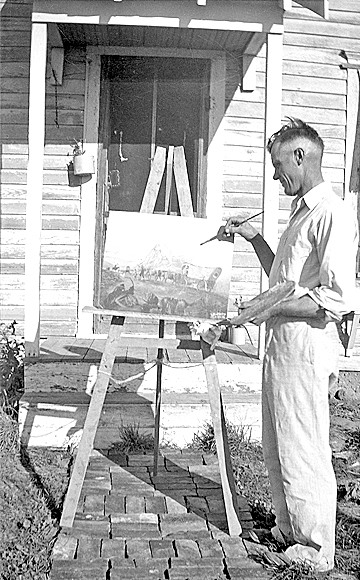
Gifting holidays, Christmas and birthdays, Grandpa Fred Mohling would choose a special extension of himself, a creative keepsake for his grandkids and children; each would receive one of his paintings, a colorful legacy which lives on today.
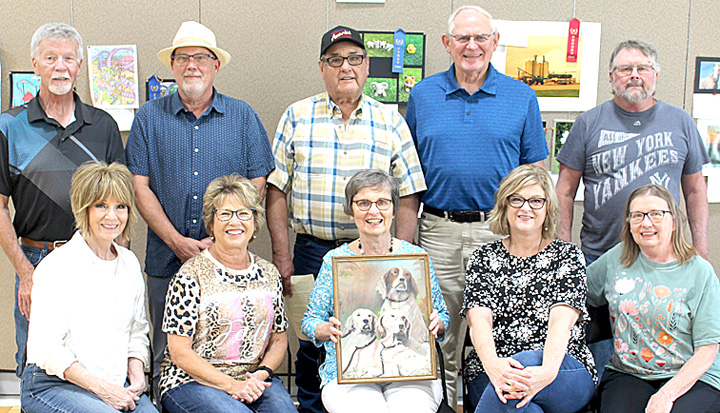
Several Mohling family relatives reunited on Thursday, August 22 in the world’s only Corn Palace armory in Mitchell, SD to spend time reflecting upon Fred Mohling’s life as an artist.
A rolling slide screen exhibit entitled “Fred Mohling South Dakota Farmer Artist 1894-1984” offered viewers projection screen snapshots of over 140 documented paintings in genres such as wildlife, Western scenes and picturesque landscapes, with only one of his known paintings featured the South Dakota ringneck pheasant. Paintings by Fred’s daughter, Maxine Miller of White Lake, were also featured in the exhibit.
Fred also created pencil drawings of some of his paintings while living in the nursing home prior to his death in 1984 at age 89.
Fred’s grandson, John Swanson of Rapid City, a retired educator, son of Dale and Eileen Swanson, and a 1978 Plankinton High School graduate began the tedious task of compiling and documenting all of Mohling’s paintings. John shares the process, “A few summers ago while we were in Wessington Springs, my sister Linda, her husband Bill, and I visited our two aunts, who are still living. We picked up Alice Vilbrandt at the Weskota Manor and went over to Alma Mohling’s house. She made us all a midafternoon snack of cookies, cake, ice cream, coffee and iced tea. It was a delicious and impressive ‘snack,’ but no problem for Alma. After all, she was only 101 at the time.
“We talked about Grandpa Fred, and Alma showed us her paintings. I took photos of each one with my phone. When we dropped her off, I also took photos of Alice’s paintings. Because it is simple to take and share photos with our phones these days, I thought it might be possible to collect more of Fred’s paintings by contacting his other grandchildren. And they came through!
“We now have photos of about 150 of Fred’s paintings and drawings. It has been a collective effort of Fred’s family which preserves his artwork and makes it available to share with others. We have even been able to receive photos of Fred’s paintings from his nieces and a nephew who are still living. My sister, Linda Roth, and cousin Greg Miller have been especially helpful in sharing their knowledge and memories of Grandpa Fred to supplement the photos.
“More of Fred Mohling’s paintings may be out there. Those who know of any should feel free to contact me at jkswanson60@gmail.com.”
Fred Mohling was born in Gladstone, Nebraska in 1894. He was the eldest of eight children of German heritage. At home, the family spoke German, but they were schooled in English and used it outside the home. In 1917 Fred married Mathilda “Tillie” Maschmann in Daykin, Nebraska. In 1920, they moved to Pleasant Valley Township, South Dakota, just south of the county line separating Jerauld and Aurora counties. They had seven children together. Tragically, Tillie passed away in 1940, leaving Fred to raise five of the minor children, with the help of the two eldest children.
He was a successful farmer, raising cattle, and selling feed. He also actively participated in community affairs. Fred might also be considered a naturalist. He enjoyed landscaping his large lawn, feeding the deer and other wildlife, building a dovecote, constructing a roofed well with bucket and rope, building swings for his grandchildren, digging a lily pool, and building an outdoor fireplace. In 1965, he traveled to Houston to see the newly built Astrodome, (8th Wonder of the World), and later to Pasadena, not for the football game, but to see the roses on display in the Rose Bowl parade. He took his family to see the Passion Play in the Black Hills, and frequently took car trips back to Nebraska.
Throughout his busy life, Fred kept coming back to drawing and painting. His interest began at the age of three or four when an uncle drew a picture for him, which he tried to copy. A good student, Fred would finish his schoolwork early and use the extra time to draw. A carpenter building his father’s house in Fairbury, Nebraska noticed Fred’s interest in art and bought him a watercolor set when Fred was about eight. At age twelve, Fred won first prize for a painting at the Old Settlers’ Picnic in Fairbury. Later in his thirties, Fred watched an artist painting a landscape at the State Fair, which rekindled his urge to paint. After his wife died when he was 46, he would often paint well into the night. His daughter-inlaw recalls of often coming home from barn dances late at night/early in the morning to find Fred still up painting. Around 1954 Fred painted a near life-sized nativity scene, which he displayed in his yard for his grandchildren to enjoy. The scene included individual paintings of the wise men, camels, other animals, and the manger with Christ and Mary and Joseph. He illuminated the display with about 100 colored and white lights attracting hundreds of people from as far as 75 to 80 miles away. Unfortunately, the scene was lost over time because Fred had painted the individual pieces on cardboard which deteriorated.
In 1957, Fred told FC Woodall, a reporter for the Mitchell Daily Republic, that “he believes that everyone is endowed with certain talents, and that his was art”. Prior to 1957, Fred had won several second and third place prizes with his State Fair entries, but in 1957 he brought home his first two Blue Ribbons. Over the years, he exhibited his work at the South Dakota State Fair, as well as places such as Clark, Faulkton, Wessington Springs, and the Corn Palace in Mitchell. His paintings hang in the Wessington Springs Museum, Augustana University in Sioux Falls, and the City of Fairbury, Nebraska Museum.
In 1971 Fred sold his farm and bought a home in Wessington Springs. His health forced him to move to Weskota Manor in Wessington Springs in 1979. By that time, it is believed that he had painted well over 100 oils. Fred continued to draw for about another four years with some of his drawings being replicas of what he painted 40 years prior. He only had three painting lessons during his lifetime.
Almost all of his paintings and drawings remain in the hands of family members.
A local historic note: Strolling through the past, Pam Vissia, one of John’s 1978 PHS Classmates, shares when her family owned Al’s I-90 Cafe in 1981 during the Plankinton Centennial celebration several of Fred Mohling’s artworks were on display in the restaurant. A late night storm came through, breaking some of the windows on the south side of the building, and Al Swearingen, with great urgency, contacted the Vissias, concerned about damage, but fortunately the Mohling paintings were spared.
Plans are in the making for John to bring the Fred Mohling exhibit presentation to Plankinton later this fall.