

This article was originally published in the January edition of Charolais Country, a product of the South Dakota Charolais Breeders Association and The Cattle Business Weekly.
On the rolling grasslands near Kimball, where the prairie opens into vast South Dakota sky, the Christensen family has built a ranching story rooted in hard work, honesty, and the belief that cattle—and kids—are shaped best through hands-on experience.
That commitment earned the family the honor of being named the SDCBA’s 2025 Commercial Producer of the Year, a recognition that still feels surreal.
“I think we were all caught off guard and super surprised when we were notified,” Christina Christensen said. “We were, and still are, very humbled by being selected for this award. We take so much pride in our breeding program, and we are honored to be noticed for such.”
The Christensen operation didn’t start as one herd. Wade had his cows; Christina had hers. When they married, the couple combined both herds and began building the home place into the family operation it is today.
Their shift toward Charolais cattle began in 2002, when Christina partnered with Eggleston Charolais and purchased 15 registered cows—a partnership that grew into shared ownership, a long-standing friendship, and eventually a major milestone.
“We’ve been breeding to Charolais bulls for almost 25 years now and enjoy what the Charolais breed offers,” Christina said.
The couple’s three sons grew up showing heifers in 4-H and open shows, gradually building their own purebred herd at home. What began as a youth project expanded into roughly 20 registered Charolais cows owned by the boys.
Then in 2023, the family purchased the entire Eggleston Charolais cow herd. “Our family has always believed that the EC herd is the Best of the Best,” Christina said. “We feel incredibly blessed to have been long-time family friends with the Egglestons.”
The move was marked with a memorable cattle drive— both families helping move the EC herd 10 miles down the road to its new home on the Christensen Ranch. Eggleston Charolais hosted their final bull sale on April 8, 2024, marking their 39th annual event. The Christensens now carry the torch forward, offering a yearly performance = profitability production sale.
Throughout their development, the Christensens have stayed grounded in the values they were raised on. “Hard work and honesty,” Christina said. “These same values were instilled in us by our parents when we were kids, and we feel it’s important to pass those values on to our boys.” Those values show up not just in cattle but in the day-to-day decisions of raising a family on the land.
Their land plays its own role in shaping cattle and character. Situated on rolling hills made for grazing, the ranch relies heavily on rotational grazing systems and fresh water sources— strategies rooted in Wade’s background.
“Wade specialized in Range Management in college and then had a job with the Lower Brule BIA as a Range Specialist,” Christina explained. “A normal drive or ride out in the pasture usually hasseveralstopsalongtheway to do plant identification… there’s constant ebb and flow of teaching and learning.”
Each family member helps the operation run in their own way.
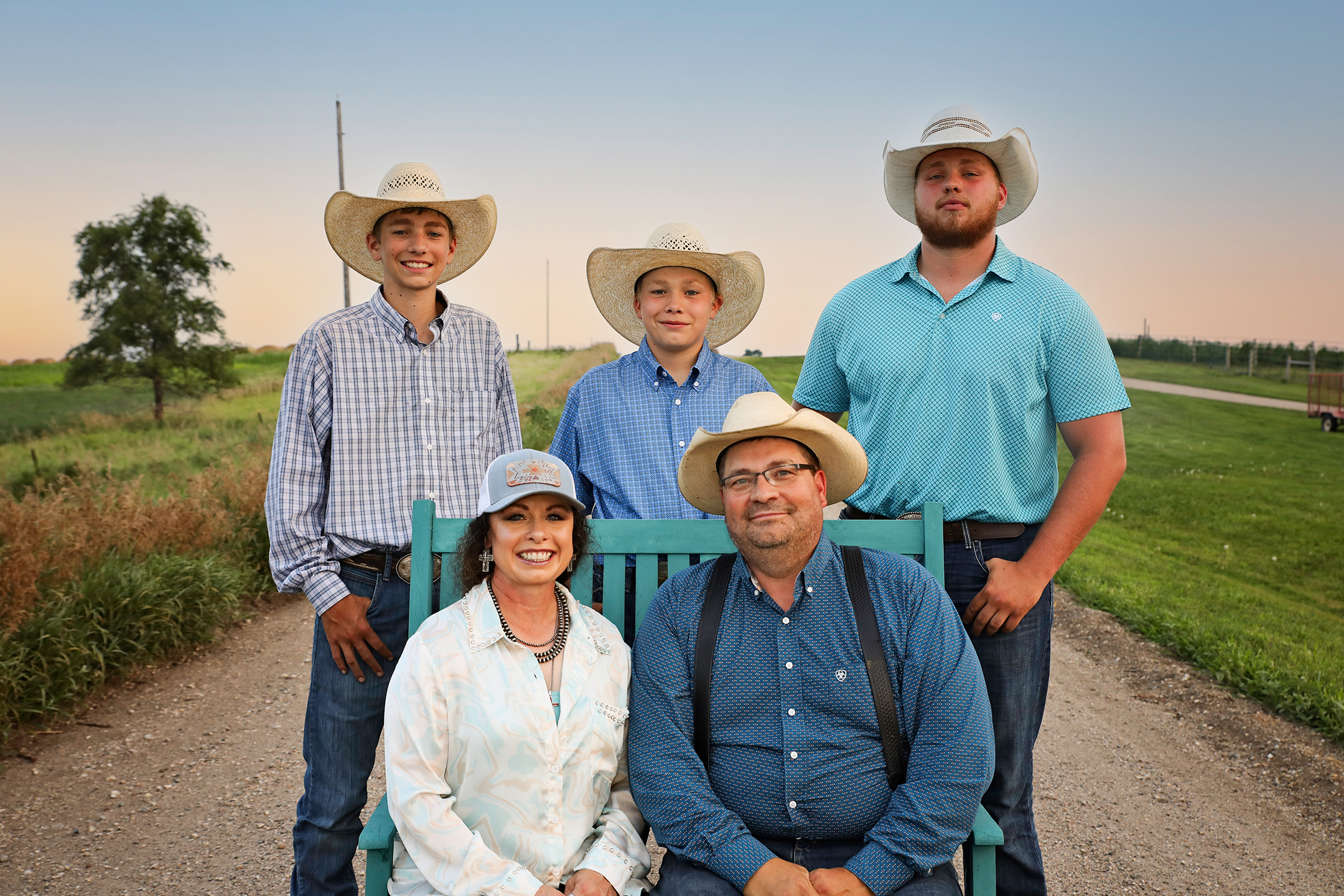
Christina handles logistics, marketing, advertising, and calving. Wade oversees land management and financial strategy. Hayes, the youngest, studies EPDs, lineage, and registrations—“he really knows the cattle.” Landen provides essential ranch work and mechanical problemsolving while studying Diesel Technology at Lake Area Tech. And Quinten contributes whenever he’s home from SDSU, where he studies Ag Business and plays Division I football for the Jackrabbits.
Their cattle program remains grounded in functionality and performance. With their ties to Kimball Livestock Exchange, they see firsthand that Charolais-influenced cattle bring pounds—and pounds matter.
“We have run a commercial herd for 30 years, but now are focused on raising purebred Charolais bulls and heifers that a commercial cattleman can invest in and add hybrid vigor and performance to their own cow herd,” Christina said.
One thing many outsiders may overlook is just how invested the entire family is.
“Our three boys each have their own interests and skill sets when it comes to our cattle operation, but each of them plays a vital role,” Christina said. “Almost every decision we make focuses on how it will move our operation into the future, where our three sons can take the reins and create their own legacy.”
Another part of that future relies on people. The Christensens emphasize working as a team—across ages, backgrounds, and experience levels. They employ one full-time worker, Kyle, who brings valuable swine-unit training and strong biosecurity awareness. They also bring in young people from the community, often pairing inexperienced workers with seasoned help.
“Some of these young individuals would not normally have had this opportunity but may have expressed interest one time, and I love to snatch that interest,” Christina said. “They may have only started by learning how to run a pitchfork, but at the end of three months, they have learned how to run equipment, recognize sick calves, work cattle, and communicate effectively.”
Their approach blends traditional ranching values with unique strengths— whether it’s Wade’s background in range science or Christina’s nursing experience.
“Being a nurse helps in various ways with taking care of injuries and deciding when we have to go in to get someone checked out or just buck up… or in managing livestock health and following protocols,” she laughed.
Challenges come with ranching, but the toughest in recent years has been trying to grow the operation, so their three sons have a sustainable future to come home to. When things get hard, they lean on their support system. “Knowing that we are surrounded by family and friends that support us,” Hayes said, “that keeps us motivated.”
The Christensens also credit their neighbors—those who help move cattle, trade equipment, rent pasture, or simply show up when needed. “The relationships you build go far beyond the cattle,” Christina said. “It is truly the greatest community to be a part of.”
Looking to the future, Christina believes commercial beef production will continue shifting toward efficiency. “We need to continue finding ways to produce more with less, all while producing a superior beef product,” she said. With a shrinking national cow herd, the role of cow-calf producers becomes even more vital.
Above all, the Christensens hope the next generation understands the importance of what they do. “One of the most important things I want them to understand is the vital role they play in feeding the world and not to take that task lightly,” Christina said. “It is a humbling task.”
And if the ranch could be summed up in one picture, Christina sees it clearly: Charolais cattle grazing in the pasture under a South Dakota sunset, the whole family standing together, looking out over the fruits of their labor.
A legacy in motion. A family rooted in purpose. And a future built on cattle, community, and the land that raised them.