


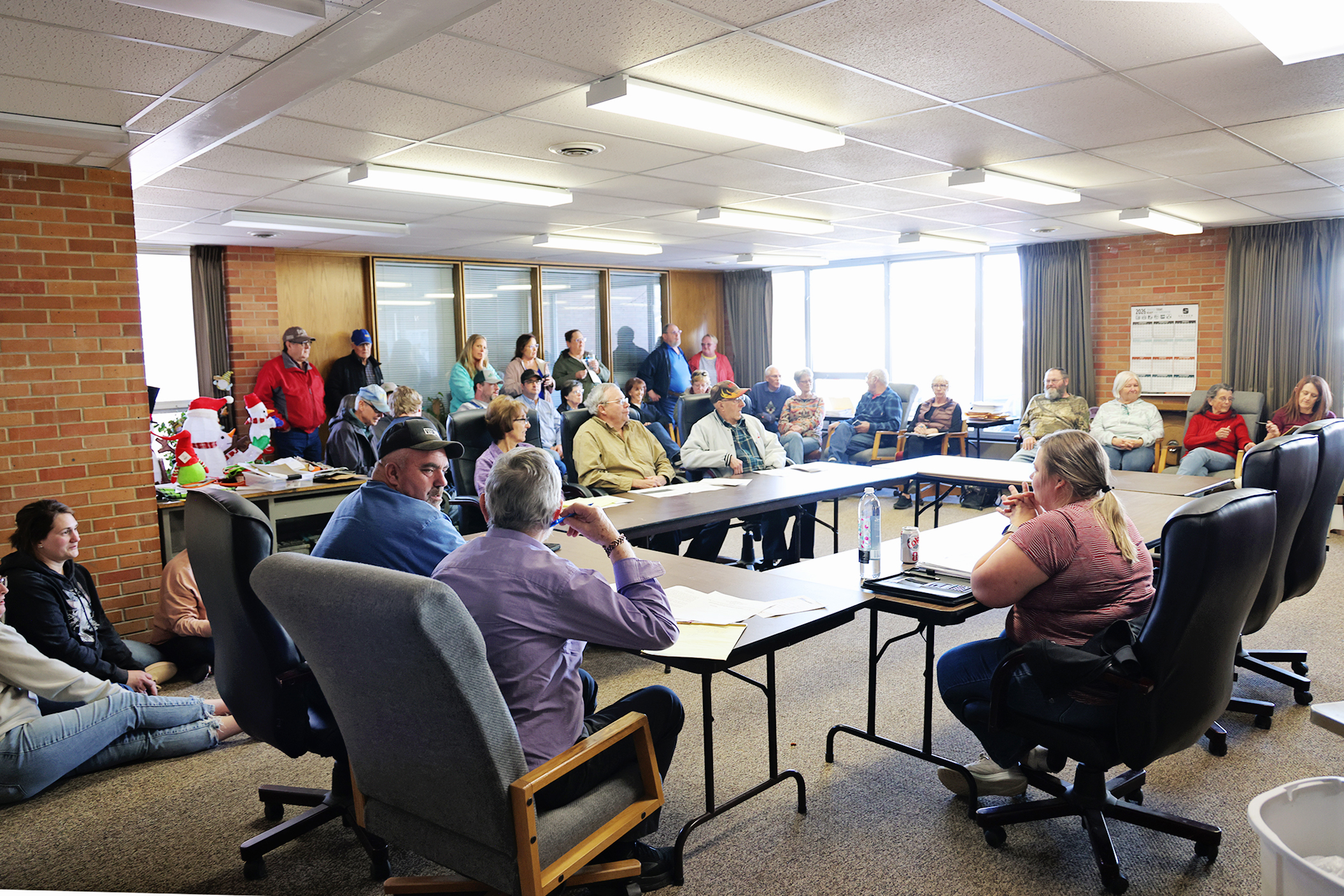
After a standing-room-only public hearing Monday evening, the Wessington Springs Zoning Board voted 3-2 to recommend denying a request to rezone land proposed for a cryptocurrency mining operation.
The board voted to recommend denial of the application to change the zoning classification of property owned by Brian and Kathy Bergeleen from agricultural to commercial. Glenn Cooper, Lila Hoffman and Lloyd Kraft voted in favor of the denial, while Ryan Knipfer and Betsy Schroeder voted against it.
The recommendation now moves to the Wessington Springs City Council for consideration at its next regular meeting in April.
The 11.3-acre property located north of prospect Hill Cemetery and south of the city's substation and generator is legally described as a plat of BLB Tract in the NE ¼ of 18-107-64 in the City of Wessington Springs.
The zoning board meeting, held Monday, March 9 at Wessington Springs City Hall, drew a large crowd, with residents filling the room and others seated on the floor as community members raised questions and shared concerns about the potential project.
City Attorney Gary Blue explained the hearing was limited to the question of zoning.
“The purpose of this meeting is to change the classification of the property from ag to commercial,” Blue said. “That’s necessary before the company would even be interested in the project. This has nothing to do with approving an agreement with the company.”
If the zoning were approved, Blue said, the city council would still need to review and approve any agreements related to the project after additional public meetings and information from the company.
The proposed project involves a cryptocurrency mining operation by Texas-based company Giga Energy. Mike Malone, chief financial officer for Heartland Energy in Madison, said the company would install four container-style units measuring approximately 20 by 60 feet.
Malone said the units would be air-cooled and would not require water.
“This facility does not use water,” Malone said. “It is aircooled by fans, and that’s where the noise comes in.”
The facility would require an estimated 10 megawatts of electricity. By comparison, Malone said the entire city of Wessington Springs currently uses about 1.43 megawatts.
Heartland Energy serves as the wholesale electricity supplier for Wessington Springs and 28 other municipalities throughout South Dakota, Minnesota and Iowa. Malone said the company has developed a special rate for large energy users so the costs of infrastructure upgrades and transmission would be borne by the customer.
“They pay all their own demand, all their own transmission and any capital costs that come into play,” Malone said.
Throughout the hearing, residents voiced concerns about noise levels, the project’s location and how the facility could affect nearby homes and community spaces.
Wessington Springs resident Sharon DiCarlo said the proposed site is located near several important community institutions.
“Our house is very close, and we have to think about the hospital, the nursing home and the grade school within three blocks of that,” she said.
Resident Chelsea Waters also raised concerns about the property’s proximity to the city cemetery.
“It’s just north of the cemetery,” Waters said. “Any noise will impact services up there. If it’s zoned commercial and something else goes in there later, it changes the peacefulness of grieving.”
Other residents questioned whether rezoning the land could allow other commercial developments in the future if the cryptocurrency facility did not move forward.
City council member Cherie Maxwell raised that concern during the meeting.
“If it gets approved commercial and they decide not to come, that commercial property is available for any commercial activity,” Maxwell said.
“That’s correct,” Blue replied.
Darrick Van Dyke of Wessington Springs urged the zoning board to consider the impact of industrial activity near residential areas, noting ongoing noise concerns on the north side of town. He also encouraged zoning board members to visit that part of town to hear the noise for themselves.
“I hear a fan-type noise running from inside my house at times,” Van Dyke said. “Maybe we need to investigate our enforcement of current rules between industrial and residential zoning.”
Questions from residents also focused on electricity rates and how the project could affect local infrastructure.
Malone said the facility would operate under an “interruptible” power rate, meaning the operation would be required to shut down within a specified time, typically about 30 minutes, during periods of peak electricity demand.
Discussion during the meeting also touched on the potential financial impact for the city. According to estimates shared during the meeting, the project could generate roughly $750,000 annually through energy sales, transmission revenue and local sales tax.
Blue said that amount would represent roughly one-third of the city’s annual budget.
“In small towns, the cost to maintain everything stays the same even if we lose population,” Blue said. “If there are fewer people to divide those costs among, it just becomes more expensive for each household.”
Bergeleen, the property owner who filed the rezoning request, said he was approached about the project because of the land’s proximity to existing transmission lines and electrical infrastructure.
He said he initially moved cautiously because he enjoys having the property as pasture.
“The hardest thing about this whole project would be selling that pasture for me,” Bergeleen said.
However, he said discussions about the potential financial benefits for the community led him to view the proposal more favorably.
“They explained to my wife and I the good this could do for the town if we can make it work,” he said.
Following the lengthy discussion and numerous questions from residents, the zoning board ultimately voted to recommend denying the rezoning request.
The matter now moves to the Wessington Springs City Council for further consideration.