

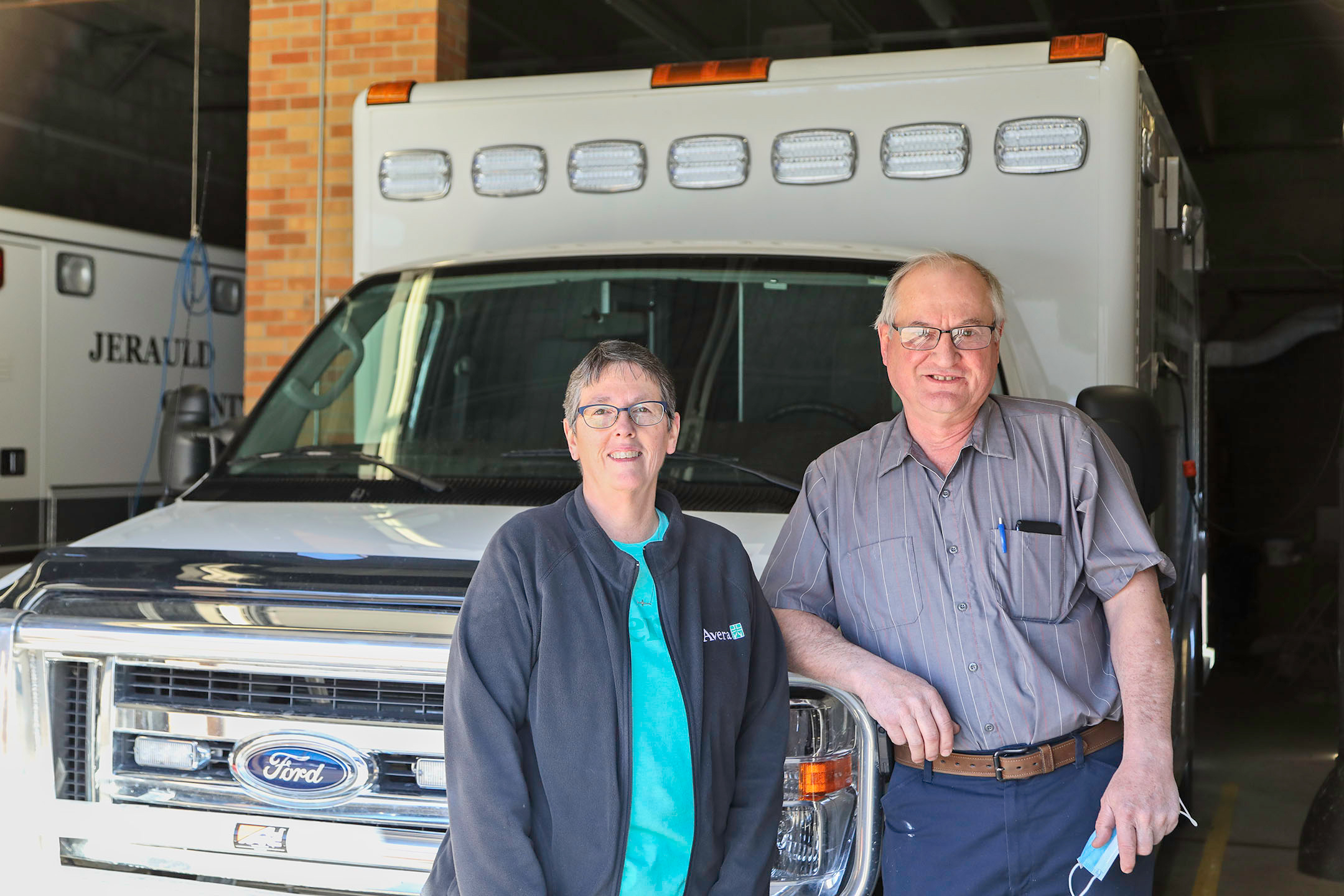
With a combined six decades of dedication to one of Jerauld County’s most vital public services, Dick and Ellen Powell have played an integral role in the success, growth and longevity of the Jerauld County Ambulance since the 1990s. Now after 37 years on the ambulance crew, 30 of which he served as ambulance director, Dick and his wife Ellen — who has 24 years with the ambulance service under her belt — have announced that it is time to retire.
“It was not a decision we took lightly,” Dick explained. “We had the helm for so long. When the county decided to set up an ambulance board and hire a paid ambulance director, it seemed like a good time to step down.”
Although they still maintain their EMT licensure, the couple is not actively taking calls. Earlier this year, they aided in the training process of Jerauld County Ambulance Director Brenda Mann, who began in the position January 3.
“When Brenda comes with questions, we do our best to answer them and to help with a smooth transition. We want nothing more than the service to be here for the area residents,” said Dick, who continues to serve as a volunteer fireman.
Looking back
The dedication to serving others through the Jerauld County Ambulance service runs deep for both Dick and Ellen, with both of the couple’s mothers having served as ambulance volunteers for years.
When Dick joined the ambulance crew 37 years ago, he said that at that time there were more than a dozen active EMTs.
“We had a pretty impressive roster, we were active,” he said of the ambulance service which at that time, was run by the county with Deach Koch serving as the ambulance director.
Officially organized in 1969, Jerauld County Ambulance initially used a hearse to transport patients, then purchased a 1970 suburban ambulance. In the early 70s, the father and son combination of Harold and Kim Schultz made approximately 100 ambulance calls per year. SEE SIDEBAR ON PAGE TWO
In the early 1990s the countyowned ambulance service turned the billing and management over to the hospital in Wessington Springs and asked Dick to be the director. Patty Keeton handled the billing and payroll.
When Ellen joined in 1998, she helped Patty with the bookkeeping services and began managing them in 2015 per the management agreement with the hospital and the county. Ellen also managed the call calendar in 2012 when the service began assigning call. The duties of the director and assistant director positions were unpaid volunteer, they were only paid per call like the other EMTs.
“With the management agreement we made it into a viable business through billing and managing the county’s assets,” Ellen explained. “The ambulance service’s bank account began with $20,000 from county and we handed it back with $200,000.”
Ellen points out that the county contributed $50,000 for a new ambulance in 2006. In 2019 the service was able to purchase another new ambulance with revenue from billing ambulance trips.
Using vacation time from their full-time jobs at Avera Weskota Memorial Hospital to take call, the Powells totals for the time period of 2017 through 2021 averaged 123 calls per year. For the same time period, Dick went on 424 calls including 139 transfers (to Sioux Falls, Mitchell, Huron, airports, etc.) and 285 emergency calls. Ellen responded to 330 calls including 92 transfers and 238 emergency calls.
“We are proud of the service we did,” Ellen and Dick both expressed. "We couldn’t have done this without the many ambulance personnel that worked the early years to establish this service and work tirelessly to keep it running.”
The Powells frequently refer to longtime EMT, Becky Leslie of Wessington Springs.
“Becky Leslie was by our side most of the time until her health stopped her from helping a year ago,” said Ellen, who pointed out that she and Becky were in the same EMT class together. “She was right there for everything, going on countless calls and transfers with us. She should be commended as well for her 23 years of active service.”
A tough, yet rewarding job
Whether responding to vehicle collisions, cardiac arrest or farm accidents the job of an EMT on an ambulance service can be both fulfilling and heartbreaking at the same time.
“When you’re doing CPR on someone and they take a breath, it is the best thing ever,” Ellen said. “Then on the other hand, the hardest part of the job is coming out of the ER and seeing the family when you know the outcome isn’t good.”
Memorable calls include responding to a trailer house that fell off the jacks when being moved, pinning a man underneath.
“Ellen crawled under the house with him while we worked on getting him out,” remembers Dick.
Another unforgettable call involved turkeys.
“A semi truck and trailer was hauling turkeys on Highway 281 and tipped on its side. There were turkeys everywhere,” Dick recalled. “We had to wait for a wrecker to tilt the semi sleeper up in order to get the driver out. Luckily, he walked away unscathed.”
EMTs don’t limit their lifesaving work to strictly the field or the ambulance. In fact, with skill levels changing including defibrillation and inserting advanced airways, oftentimes after returning from a call, they stay and help in the ER if asked by the nurses or doctors.
“One Christmas Day I remember helping Dr. Tom (Dean) put a hip back in place,” Dick recalls. “He trusted us and was our medical director all those years. He was always appreciative.”
Ellen turns to the part of the job that goes beyond medical skill and knowledge.
“It’s not just going in to take care of the patient. Most of the time the family is around and in need of a hug or emotional support,” she said. “Home deaths are tough. For first time EMTs experiencing their first death is difficult. EMTs who have been at it awhile serve as counselors too, helping them talk it out.”
Over the years the Powells are grateful for all of the thank you cards and letters they received.
“Many times, days after you drop off a patient you wonder how they are doing. It’s such a blessing to open the mailbox or the Card of Thanks section in the newspaper and find out,” Ellen said with a heartfelt smile. “Sometimes it brings tears but it makes you realize what you do matters and it makes all the calls worth it. We know we were appreciated.”
Free but busy weekends
“I can’t keep grandma home anymore,” laughs Dick, commenting on the frequency in which he and Ellen travel to Sioux Falls to see their twin infant granddaughters.
Ellen was quick to chime in: “Like grandpa can’t wait to go and see them!”
Pulling out his phone with a big, proud smile, he gushed, “Alright I’ll show you a picture.”
After decades of having to carefully plan out of town trips due to being on call, the new grandparents are ecstatic about seeing their granddaughters every other week while “trying not to wear out our welcome.”
Despite enjoying their new found freedom, both Dick and Ellen say they miss serving patients and the camaraderie with other EMTs .
“We are so appreciative to all the past EMTs and drivers that we have worked with over the years that gave of their time and talents. We all gave up a lot,” she said. “I have a saying that has been taped to my desk for many years from Maya Angelou” ‘People will forget what you said, people will forget what you did, but people will never forget how you made them feel.’”