

Scientific survey shows 53% of respondents support Constitutional Amendment G, which would reverse South Dakota's abortion ban. Opponents vow a court challenge.
Support for a 2024 ballot amendment that would enshrine abortion rights in the state constitution is growing, reflected by a nearly 20-point margin between residents who said they are for the measure and those who oppose it, according to a scientific poll co-sponsored by South Dakota News Watch.
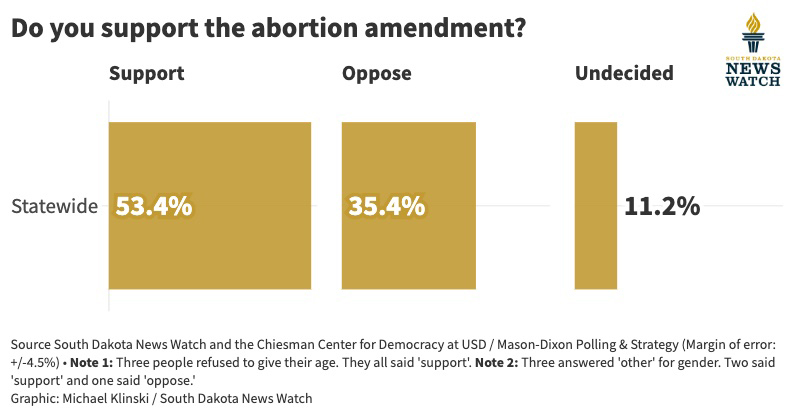
The statewide survey of 500 registered voters, also sponsored by the Chiesman Center for Democracy at the University of South Dakota, showed that 53% of respondents support Constitutional Amendment G. If passed, it would reverse a state abortion ban enacted when the U.S. Supreme Court overturned Roe v. Wade. The measure is opposed by 35% of those polled, with 11% undecided.
That’s a big swing from a News Watch poll conducted in November 2023, when 46% of respondents said they were for the measure and 44% were against it.
Perhaps most notable is the fact that 46% of Republicans polled in the most recent survey said they support codifying legal abortion in South Dakota, with 41% opposed and 14% undecided.
Rick Weiland, co-founder of Dakotans for Health, a grassroots organization sponsoring the amendment, said the poll indicates more people are paying attention to an issue seen as one of the key dividing lines in 2024 national and state elections.
“I really believe that more people are tuning in to this,” said Weiland, a former Democratic U.S. House and Senate candidate. “(South Dakota) is operating under one of the most extreme abortion bans in the country, and there’s been a backlash. People want common-sense reproductive health care options in a state where that freedom has been taken away.”
The co-founders of Life Defense Fund, an anti-abortion group formed to provide organized opposition to the amendment, said in a statement to News Watch that more information will lead to shifting opinions on the issue.
'The devil is in the details, and the more people learn that this extreme amendment approves lateterm abortion and bans physical health protections for mothers, the more they will reject it,' Republican state legislator Jon Hansen and longtime anti-abortion advocate Leslee Unruh said in the statement.
'Complex or confusing language'
Mason-Dixon Polling and Strategy conducted the survey May 10-13. Those interviewed were selected randomly from a telephone-matched state voter registration list that included both landline and cellphone numbers. Quotas were assigned to reflect voter registration by county. The margin of error is plus or minus 4.5 percentage points.
South Dakota is currently under a 2005 state trigger law activated in June 2022, when the Supreme Court left it up to states to determine reproductive rights with its ruling in Dobbs v. Jackson Women’s Health Organization.
The law makes it a Class 6 felony for anyone “who administers to any pregnant female or prescribes or procures for any pregnant female” a means for an abortion, except to save the life of the mother. South Dakota is one of 10 states that has banned abortion and does not include exceptions for rape and incest.
The constitutional amendment would prevent the state from regulating abortions during the first trimester (0-13 weeks). During the second trimester (14-26 weeks), the state could regulate the abortion decision, but any regulation must be reasonably related to the physical health of the mother. During the third trimester (27-40 weeks), abortion could be prohibited except if it is necessary to preserve the life or health of the pregnant woman, according to her physician.
The fact that 11% of respondents are still undecided on such a prominent issue could be a sign that voters have questions about specifics of the proposal, said Julia Hellwege, an associate political science professor at USD and incoming director of the Chiesman Center.
'Closely aligned' with Roe v. Wade
Rep. Hansen has cited a lack of 'safety protections' in the amendment such as parental notification, waiting periods and informed consent, adding that the measure's language is “far more extreme than Roe v. Wade itself.'
Weiland and others pushed back on that statement by saying the amendment uses the same trimester framework as Roe, the landmark 1973 ruling in which the Supreme Court held that the Constitution protected a woman’s right to an abortion prior to the viability of the fetus.
In South Dakota, before Dobbs and the trigger law, informed consent meant that doctors were required to tell patients that women who undergo abortion procedures could experience depression and suicidal thoughts and that the procedure would “terminate the life of a whole, separate, unique, living human being.”
These state restrictions were not permissible under Roe v. Wade.
They were passed after Planned Parenthood v. Casey, a 1992 Supreme Court ruling that upheld the basic tenets of Roe but overturned the trimester framework and used a more flexible standard as to whether state-imposed restrictions were constitutional.
Based on this, supporters can be taken literally when they say South Dakota's abortion amendment is an attempt to codify Roe v. Wade, according to Hannah Haksgaard, a professor at the USD School of Law.
“The proposed amendment is very closely aligned with the original Roe v. Wade framework,” Haksgaard told News Watch in 2023. “The language mimics the trimester framework of Roe v. Wade and nothing in this amendment indicates any abortion rights more extreme than that.”
Men, women show similar support
There was not much difference between the attitudes of men and women in the most recent poll, with male voters supporting the abortion measure by a margin of 54% to 36% and women supporting it 53% to 35%.
The November 2023 survey showed just 41% of women supporting the measure compared to 50% opposed. Men were in favor by a margin of 51% to 37%.
Weiland said stakes have been raised for South Dakota women because of the 2024 presidential election and the Supreme Court weighing a case involving the accessibility of mifepristone, the primary drug used for medication abortions.
News Watch has reported that several hundred South Dakota residents have traveled to Minnesota for online consultations and prescriptions to terminate pregnancies since South Dakota’s ban went into effect. A crackdown on mailorder abortion pills could close another door for those seeking reproductive health care.
This story was produced by South Dakota News Watch, a nonpartisan, nonprofit news organization. Read more in-depth stories at sdnewswatch.org and sign up for an email every few days to get stories as soon as they're published. Contact Stu Whitney at stu.whitney@sdnewswatch.org.