

Parishioners press church leaders for answers about future of Catholic presence in Wessington Springs
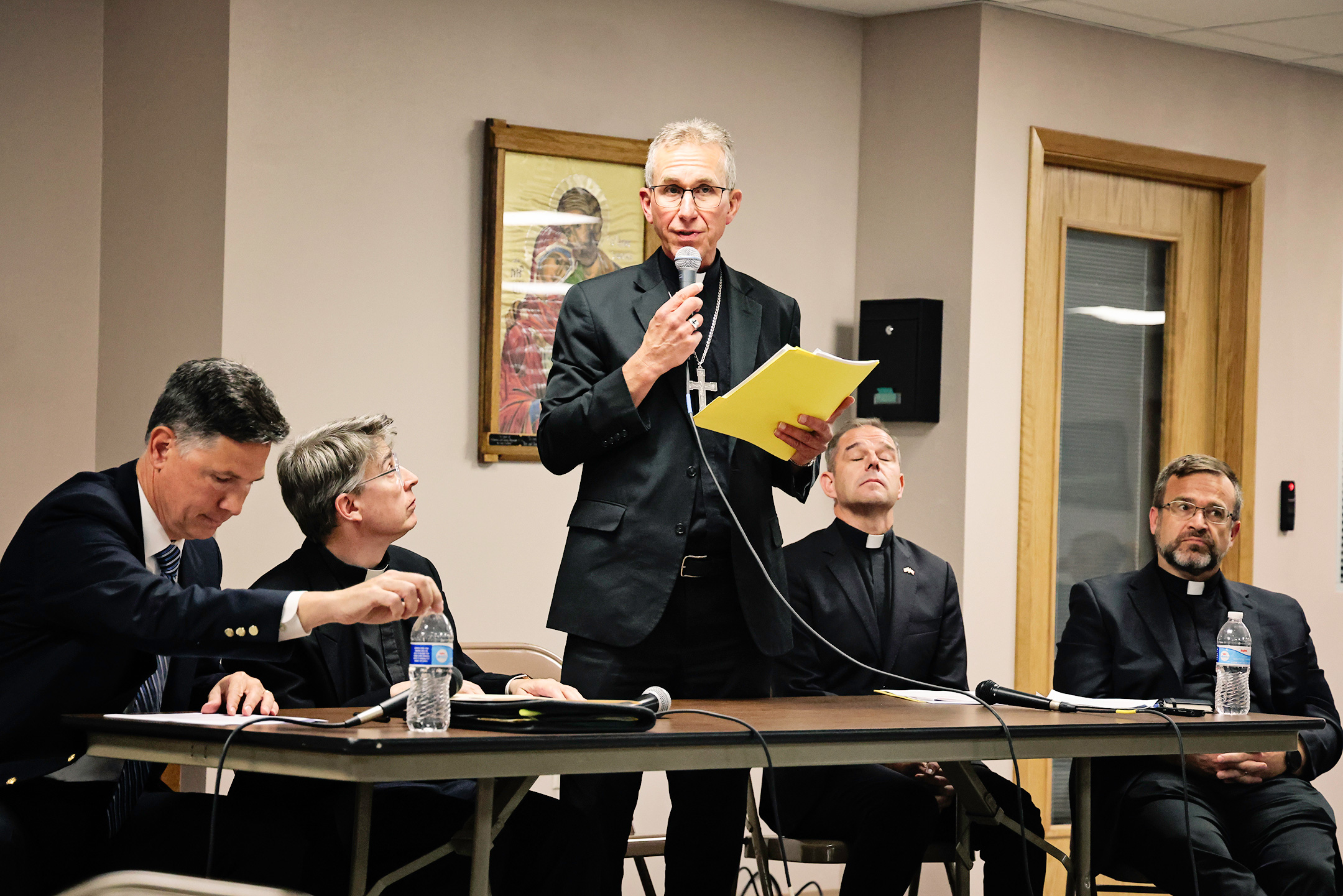
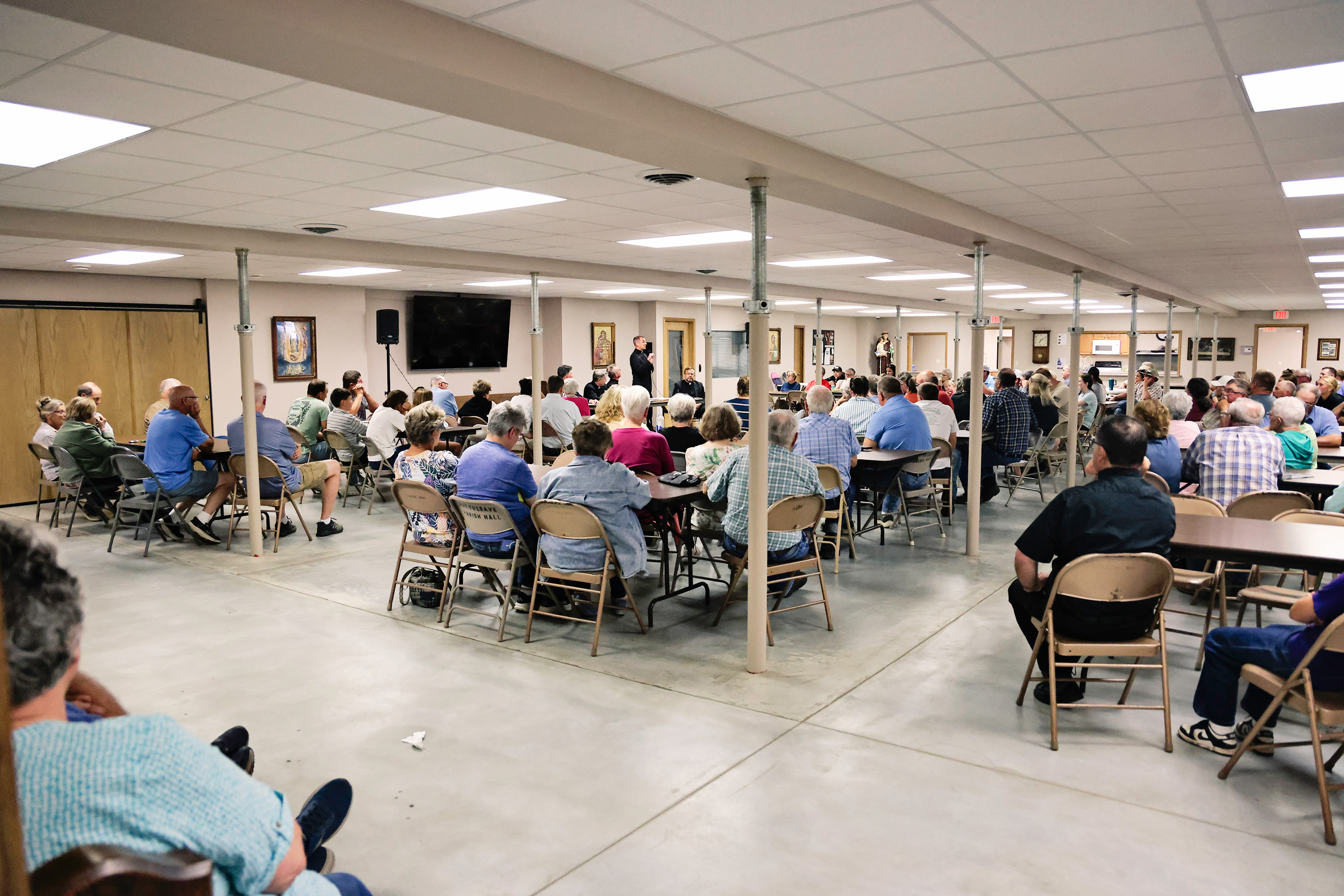
A room filled with St. Joseph parishioners and supporters fell silent Thursday night as Bishop Donald DeGrood delivered the news many had spent nearly eight months fighting to prevent.
The Catholic Diocese of Sioux Falls will not allow St. Joseph Catholic Church in Wessington Springs to be rebuilt following the Dec. 26 fire that heavily damaged the church.
“I have decided that there will not be a rebuilding of the church,” DeGrood told those gathered Aug. 20 in the basement of St. Wilfrid Catholic Church in Woonsocket. “I know this is painful, and I can only imagine how disappointing this news is to receive.”
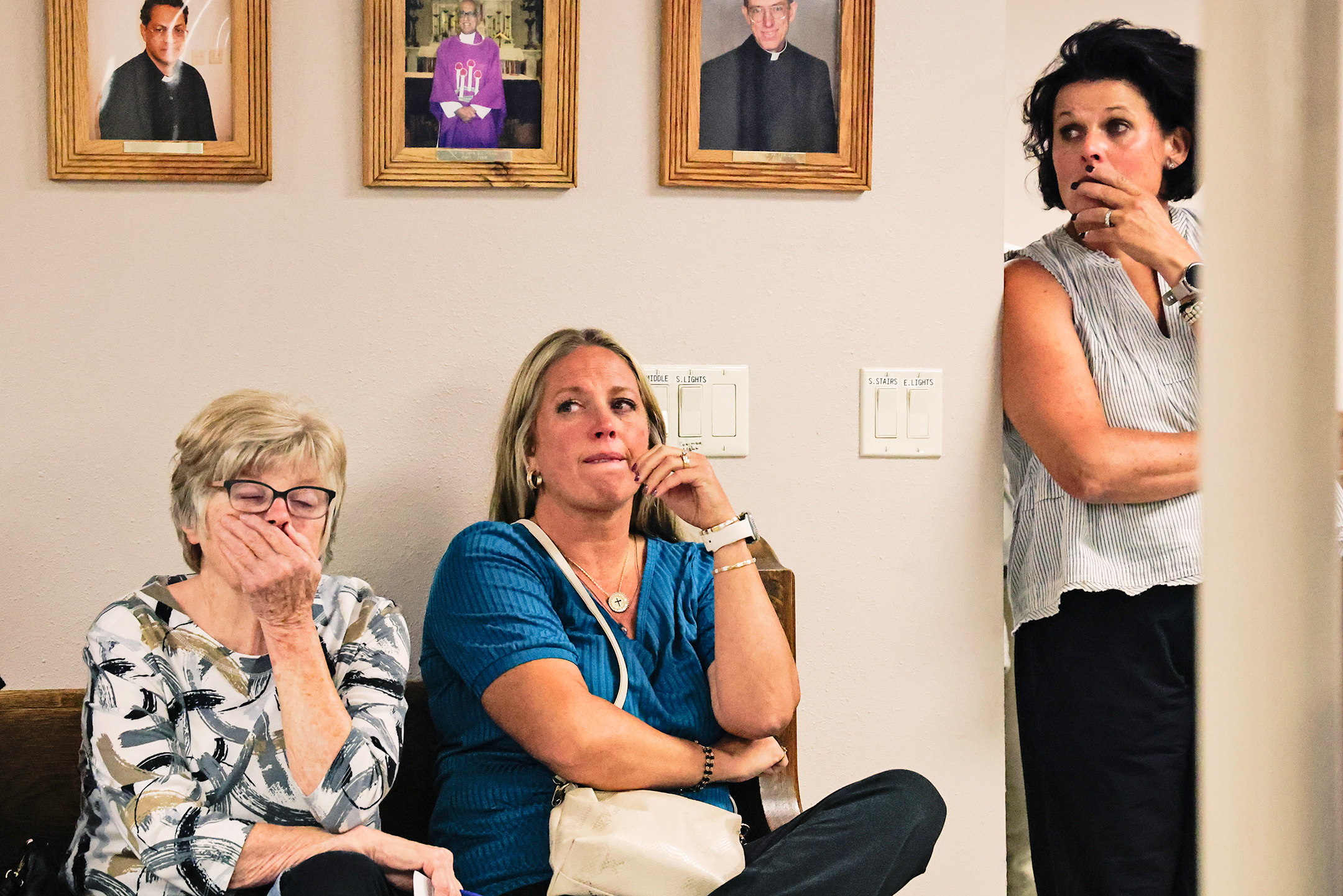
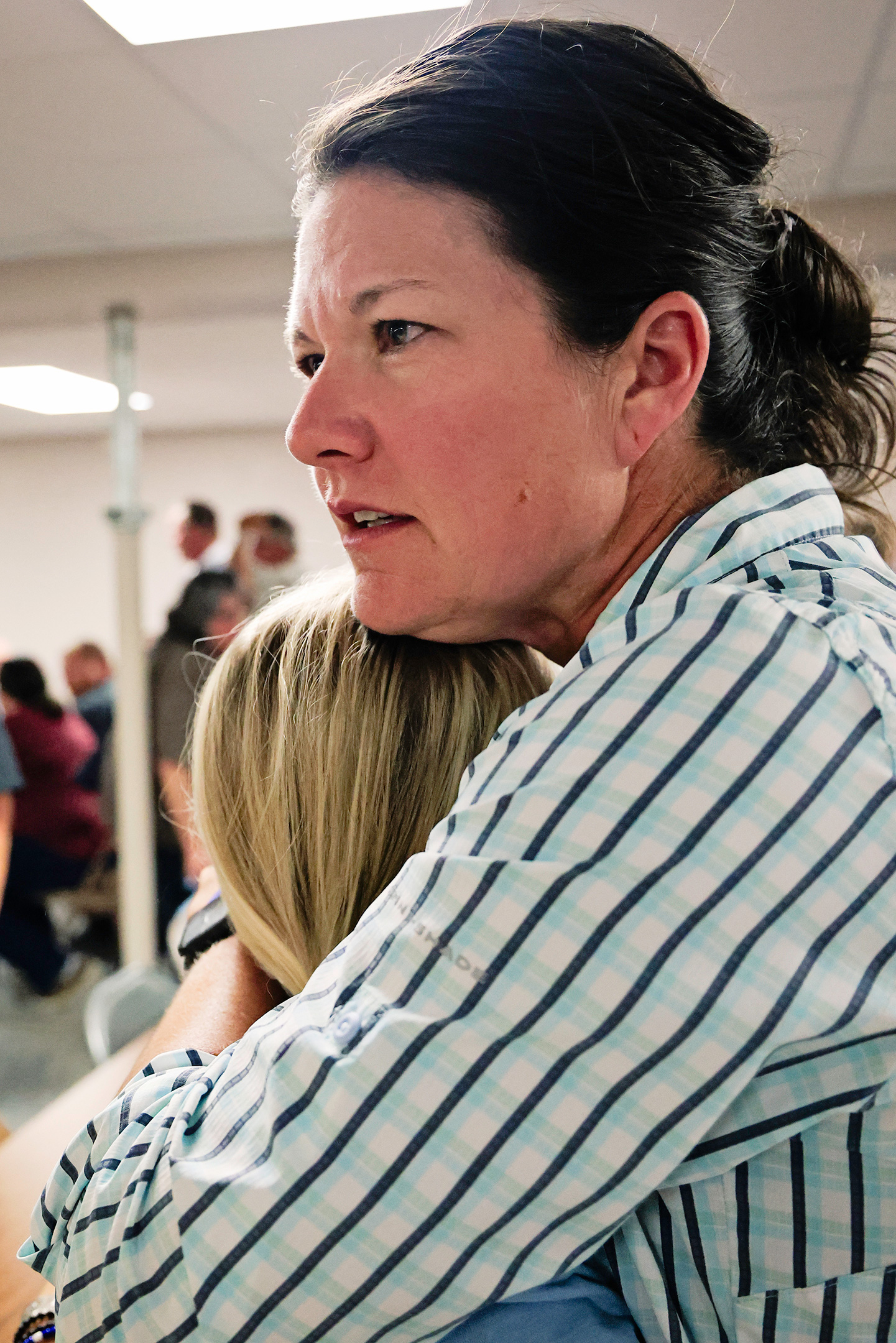
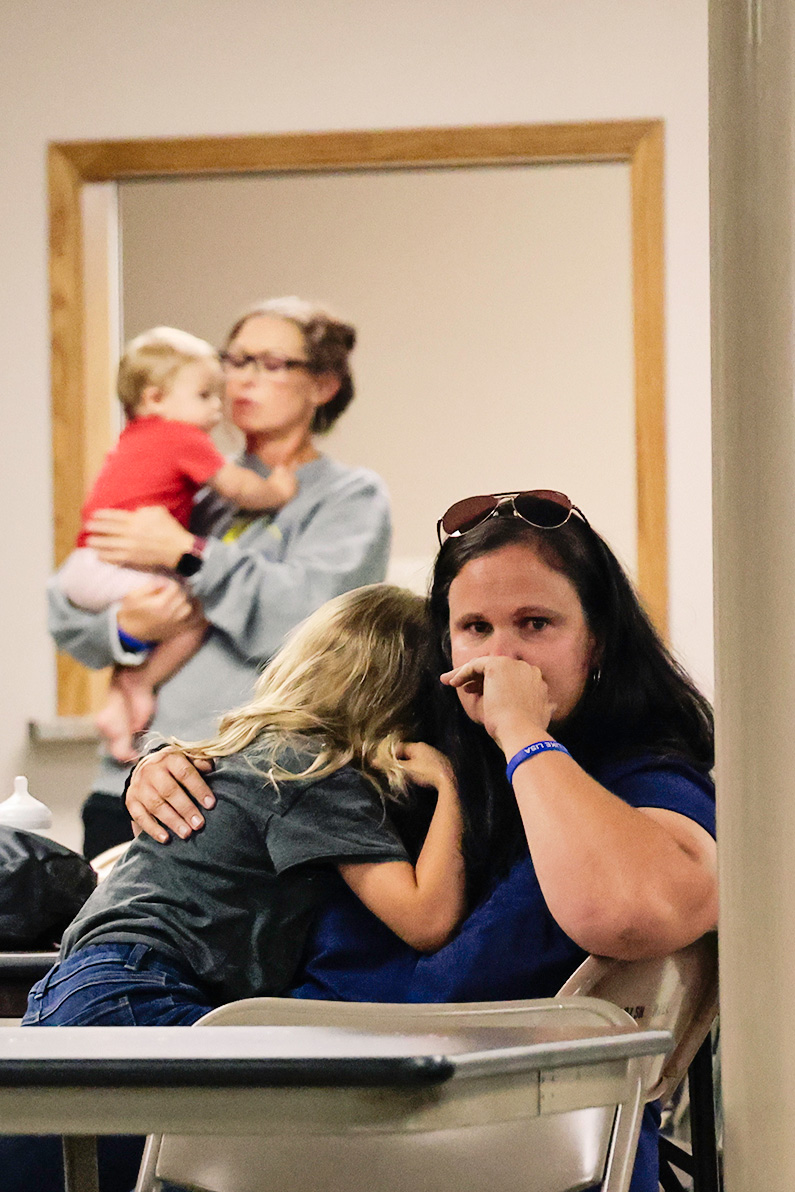
Gasps followed. Some parishioners put their hands to their faces. Parents hugged children as tears spread through a room filled not only with St. Joseph parishioners, but Wessington Springs community members of different faiths who came to show their support.
Concern over the decision has extended well beyond St. Joseph parishioners. Local business owners, members of other churches and community residents have expressed worry about what the loss of a longstanding and active church presence could mean for Wessington Springs as a whole. With St. Joseph drawing a sizable congregation, community members say its absence could have ripple effects beyond faith life, including fewer people gathering, shopping and spending time in Wessington Springs — another loss for a rural community working to keep its institutions, businesses and population strong.
The announcement began an emotional meeting that stretched through explanations of finances, demographics and a growing shortage of priests before opening to questions from parishioners who repeatedly returned to one central issue: Why St. Joseph?
Diocesan leaders said there was no single reason.
DeGrood said he made the final decision after reviewing communications asking that the church be rebuilt and consulting the Diocesan Finance Council, College of Consultors and other senior priests.
Deacon Rob Rysavy, chief of operations for the Diocese of Sioux Falls, said diocesan leadership has discussed St. Joseph's situation weekly since January. He and other diocesan officials have made multiple visits to the area, reviewed insurance and financial information and received numerous letters and emails from parishioners.
But when Todd Grohs asked church leaders to identify the criteria that ultimately tipped the decision against rebuilding, the answer remained broader.
“Is it because of the priest? Is it financial?” Grohs asked. “What's the reason you're closing our church?”
Rysavy said there would not be one data point that determined the outcome.
“At the end of the day, if there are not enough priests, then we cannot service all the parishes that we have,” he said.
Priest shortage looms over decision
Much of the diocese's explanation centered on what church leaders described as a critical and worsening priest shortage.
The Very Rev. Andrew Young, vicar general, said the diocese currently has 74 active priests. Seven are religious-order priests who could be reassigned by their orders, two are foreign priests from Africa and three are already serving beyond retirement age.
Removing those priests would leave 65, the minimum Young said is needed simply to staff every pastorate established through the diocese's Set Ablaze restructuring.
That does not account for priests serving in other roles, including vocation work or hospital chaplaincies.
Young said the situation is expected to tighten further as priests retire. By 2029, he said, five priests are projected to retire while the diocese expects no ordinations in either 2029 or 2030.
Rysavy said the diocese has lost a net 27 priests over the past six years through retirements, deaths and other departures compared with ordinations.
“Our priest shortage is critical,” he said.
The Very Rev. Andrew Dickinson, vicar general for Set Ablaze, said the restructuring was designed inparttocreateasustainable way of supplying priests to parishes through 2033. Even then, however, the plan anticipated some churches would lose Sunday Masses.
Projections for future ordinations have since become more challenging than expected, he said.
“In some ways, it's easier for a bishop to raise money than it is for a bishop to raise priests,” Dickinson said.
Parishioners question why St. Joseph
Parishioners did not dispute that the priest shortage is real. Instead, several questioned why it should prevent St. Joseph from rebuilding now, particularly when the parish has insurance proceeds and currently has priests serving its pastorate.
Grohs asked why Mass schedules could not be adjusted so every church within the pastorate receives one Mass rather than some churches receiving multiple Masses.
He also questioned why the diocese is allowing construction of a new church elsewhere while refusing to allow St. Joseph to rebuild.
Rysavy said one new church is being constructed in the diocese because the nearest existing parish is “bursting at the seams” and does not have room for its parishioners.
His comment that Catholics in southern Sioux Falls were driving across the area for Mass prompted a loud response from the room.
“We drive!” several people called out.
Another shouted that St. Joseph filled its church.
“You don't fill the church every Sunday,” DeGrood responded.
Grohs acknowledged St. Joseph was not full every Sunday, but countered that churches he has attended in Sioux Falls are not always full either.
DeGrood said the decision involved a “multiplicity of reasons,” including county demographic projections, sacramental records, Mass attendance and parish finances.
“You have to be able to operate in the black,” DeGrood said.
“We have,” Grohs responded.
“Not every year have you been in the black,” DeGrood said.
Those exchanges highlighted an issue parishioners returned to throughout the meeting: They believe St. Joseph has remained a viable parish, and several questioned the financial and attendance information being used to judge its future.
Former St. Joseph Finance Council member Scott Kolousek asked directly why the Diocesan Finance Council did not consider St. Joseph financially sustainable.
He recalled priests previously describing St. Joseph’s as among the most financially sound within the four-church pastorate and said St. Joseph had operated in the black most years.
Kolousek also questioned why the parish had paid to fully insure its church if it would not be permitted to rebuild after a catastrophic loss.
“Why, since we are fully insured, why are we not allowed to rebuild?” he asked.
$2.5 million, but no new church
The parish is expected to receive approximately $2.5 million through insurance proceeds Rysavy explained that the diocese operates under a self-insurance program, meaning losses ultimately affect premiums paid by other parishes.
He said diocesan leaders determined rebuilding was financially feasible because the church was insured. The larger question, he said, was whether rebuilding was sustainable.
“If we rebuild that church and in five years there's no priest and we can't support the church, how does that feel when we have this conversation five years from now?” he said.
Instead, the approximately $2.5 million insurance payment will remain with the parish, according to Rysavy, and St. Joseph parishioners will be asked to develop recommendations for how it should be used.
Those ideas could include investments in youth faith formation, retreats, marriage enrichment or potentially facilities in Wessington Springs.
The community must develop a proposal and take it to its pastor, Father Larry Regynski. From there, the proposal would go to the bishop. Projects above certain financial thresholds require additional diocesan consultation before DeGrood makes a final decision.
When Julie Bruckner asked whether parishioners could use some of the money to build or purchase a facility in Wessington Springs for religious education and other parish needs, Rysavy encouraged the community to develop a proposal.
Bruckner said transporting children to another community for religious education after school activities could make it increasingly difficult to keep young people engaged in their faith.
She also raised concerns about funerals and the practical difficulties families have already experienced transporting food, supplies and people to another community.
Those concerns drew applause from the audience.
‘She wants a church in her town’
For parents in the room, the debate over demographics and sustainability became much more personal.
Erin Yost stood with her children nearby and told church leaders that parents work every day to keep their children close to Christ and the Catholic faith.
Her kindergarten daughter, she said, wasn't crying because she was tired.
“She's crying because she wants a church in her town,” Yost said.
She questioned how parents were supposed to convince their children to remain strong in their faith while access to their church became more difficult because of a tragedy.
Rysavy responded to Yost's statement that the priest shortage was not St. Joseph's problem.
“It is our problem,” he said. “It's all of our problems.”
He encouraged Catholics to talk with young men about discerning the priesthood and said the shortage is a challenge facing the entire church.
Later in the meeting, Yost’s kindergartner daughter distilled the debate into a single sentence.
Gentry Yost, a student at Wessington Springs Elementary School, walked to the microphone.
“Everybody in this room wants their church back,” she said.
The room erupted in applause as more tears flowed.
What happens to St. Joseph Parish?
Despite the decision not to rebuild the church, diocesan leaders stressed that they are not dissolving St. Joseph Parish.
Theresa Hoarty, St. Joseph's homebound communion minister, asked what that distinction means in practice.
“How does St. Joseph's maintain a presence? How do we maintain a community?” she asked. “Because it's a strong community.”
Hoarty said parishioners overwhelmingly want to remain members of St. Joseph rather than simply disperse into other churches.
“We need the presence of the sacrament,” she said. “We need the presence of the Eucharist in Wessington Springs, even if it's something small.”
Rysavy told the crowd to remember that a parish and a church building are not the same thing.
“The parish is you,” he said. “The parish is the people. The church is a building. The parish is the kingdom.”
But parishioners questioned how that community can remain intact without a physical Catholic presence in Wessington Springs.
Hilary Grohs raised concerns about elderly and less-mobile Catholics who cannot easily travel for Mass and the sacraments.
“How do you propose we take care of elderly and less fortunate that can't just drive 60 miles to church?” she asked.
DeGrood pointed to laypeople helping elderly Catholics, bringing them Communion and assisting them in watching televised Masses when they cannot attend.
Grohs said that did not answer the larger concern.
She told the bishop she did not understand or agree with his decision and did not believe the diocese had fully considered St. Joseph's circumstances.
Her comments drew sustained applause.
DeGrood said he had read the letters and documentation submitted by parishioners and understood their disappointment, but said the diocese is confronting circumstances it cannot entirely control.
“I don't know we'll have two priests here next year,” he said. “I can't even guarantee that.”
He said he would continue to do the best he could with the resources available.
‘Our church is gone’
Regynski, pastor of St. Joseph and the other churches within the pastorate, closed the meeting by reflecting on the first time he drove into Wessington Springs after the Dec. 26 fire and saw smoke from miles away.
He wondered then whether the last Mass he had celebrated at St. Joseph would truly be the last.
For the past seven months, he said, it had felt as though the church building was on “life support.”
“Tonight I think I heard the parish is still alive, but our church is gone,” Regynski said.
He compared the loss to the death of his father — something painful that brought anger and questions but eventually required him to determine how to move forward.
Regynski said he does not know what St. Joseph's future will look like or what the diocese ultimately will approve. He encouraged parishioners to consider possibilities, including a place for children and programs that could strengthen the parish.
But, he said, they will have to determine that future together.
He ended with words from St. John Henry Newman's “Lead, Kindly Light.”
“I do not ask to see the distant scene; one step enough for me,” Regynski said. “I think that's where we're at as a parish. It's just one step at a time.”