

The boards that oversee South Dakota’s 10 public colleges are drafting policies in accordance with a new state law that will allow students to carry concealed weapons on campus.
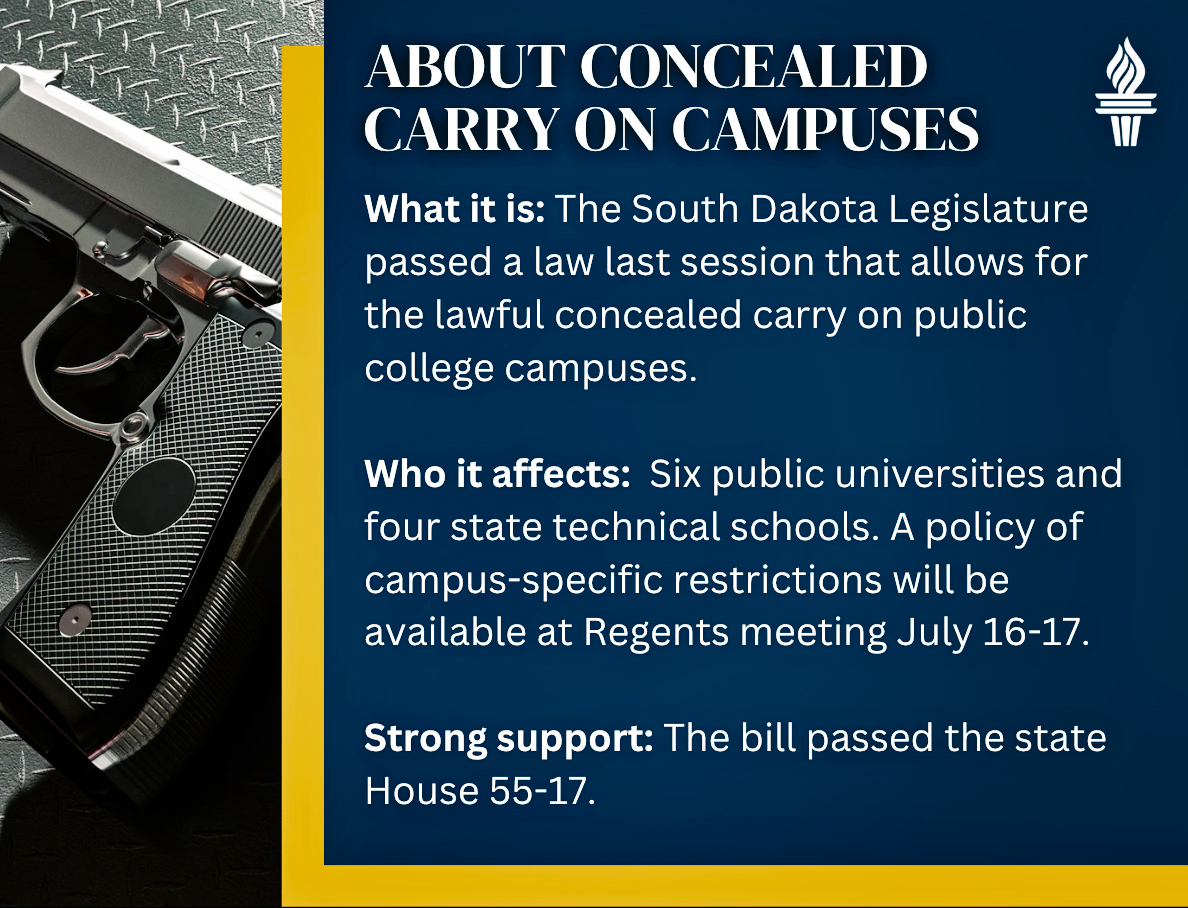
Starting July 1, the four-year and technical institutions will no longer be able to restrict the lawful concealed carry of firearms and weapons on campuses.
Senate Bill 100 (SB 100), which Gov. Larry Rhoden signed into law on March 31, makes South Dakota the 12th state to allow concealed carry on college campuses. It applies to students 18 and older and staff members who have an enhanced permit that requires the person to take a handgun safety course and abide by other requirements.
South Dakota is a constitutional carry state as of 2019, meaning anyone over 18 that can legally possess a firearm does not need a permit to lawfully conceal carry. Prior to SB 100’s passage, individual schools set their own policy regarding concealed carry on campus. No regental or technical institution permitted weapons or firearms on campus.
“The safety and wellbeing of students, employees and guests will always be our top priority,” Shuree Mortenson, director of communications for the Board of Regents, said in an email to News Watch. “We have been in communication with all our universities to navigate this change.”
Campus-specific restrictions to comply with the new law are not yet in place, and a draft policy will be available at the Board of Regents meeting July 16-17.
Regental campuses are currently working on identifying spaces where guns will be restricted and developing the proper notifications, Mortenson said.
Those campuses are Black Hills State University in Spearfish, Dakota State University in Madison, Northern State University in Aberdeen, South Dakota School of Mines and Technology in Rapid City, South Dakota State University in Brookings and the University of South Dakota in Vermillion.
Technical and private colleges
The new law also applies to the states’ four technical colleges: Lake Area Technical College in Watertown, Mitchell Technical College in Mitchell, Southeast Technical College in Sioux Falls and Western Dakota Technical College in Rapid City.
Prior to this bill, all four institutions banned firearms and weapons on campus.
TheSouthDakotaBoard of Technical Education, which oversees the four campuses, will implement a new system-wide policy to comply with the law. Executive Director Nick Wendell said the goal is to have a policy affirmed by July 1.
While the policy will be system-wide, Wendell said institutions will individually determine whether or not there are certain environments where they will provide secured storage.
Wendell doesn’t envision dramatic changes to the campus environment with this bill.
“I think we have lots of folks in our communities and already on our campuses that maybe had an interest in concealed carrying,” Wendell said. “This just ensures that everybody is aware of what the parameters are on concealed carry.”
SB 100 does not apply to private institutions. All private schools in South Dakota have policies against allowing concealed carry on campus, and none plans to change in response to the new law.
Student perspectives
Blake Gibney, a recent South Dakota State University graduate, supports SB 100. Gibney served as a senator on SDSU’s Students’ Association. He voted no on a Students’ Association resolution in February that opposed SB 100.
Gibney enjoys South Dakota’s constitutional carry law. He currently owns a gun and concealed carries without an enhanced permit. If he wasn’t moving out-ofstate, he would have gotten his enhanced permit to carry on campus, he said.
Gibney thinks requiring an enhanced permit for on-campus carrying was important to include in the bill.
“I do enjoy constitutional carry,” Gibney said. “But the 18- to 21-year-old component of having that at a university, an educational-based institution, I think (the enhanced permit requirement was) appropriate.”
Hannah Meland, who was a junior at the University of South Dakota last school year, told USD student newspaper The Volante that she opposes the law.
“Statistically, college is one of the hardest times on mental health and by allowing guns on campus, I feel we are allowing more opportunities for unsafe situations involving a firearm to occur,” Meland said.
Concerned about increased suicides
College campuses have been relatively safe compared to other settings when it comes to gun violence, said Jaclyn Schildkraut, a national expert on school and mass shootings and executive director of the Regional Gun Violence Research Consortium.
“We know that they (colleges) are not immune to gun violence, whether that’s random incidents of gun violence or a mass shooting or things of that nature,” Schildkraut said. “Those things can happen anywhere. They happen in red states, blue states, they happen in big cities, they happen in rural areas, they happen all over the place. But by and large, our campuses are incredibly safe.”
One risk with increased firearms, particularly in dorms, is suicide. The part of the brain that handles impulse control is not fully developed until age 25.
Individuals are at a much greater likelihood to be the victim of suicide than the victim of homicide, Schildkraut said.
“When you’re feeling very suicidal, you’re not thinking about, ‘How do I take a pause and get through this?’ It’s, ‘Oh my God, I need to deal with it right now,’” Schildkraut said.
This story was produced by South Dakota News Watch, an independent, nonprofit organization. Read more stories and donate at sdnewswatch.org and sign up for an email to get stories when they’re published. Emily DeCock is a student at South Dakota State University in Brookings. She received the 2025 Jeffrey B. Nelson Investigative Journalism Endowed Internship and Chuck Raasch and Sandy Johnson Scholarship from the SDSU Foundation. Contact Emily: emily.decock@sdnewswatch.org.