


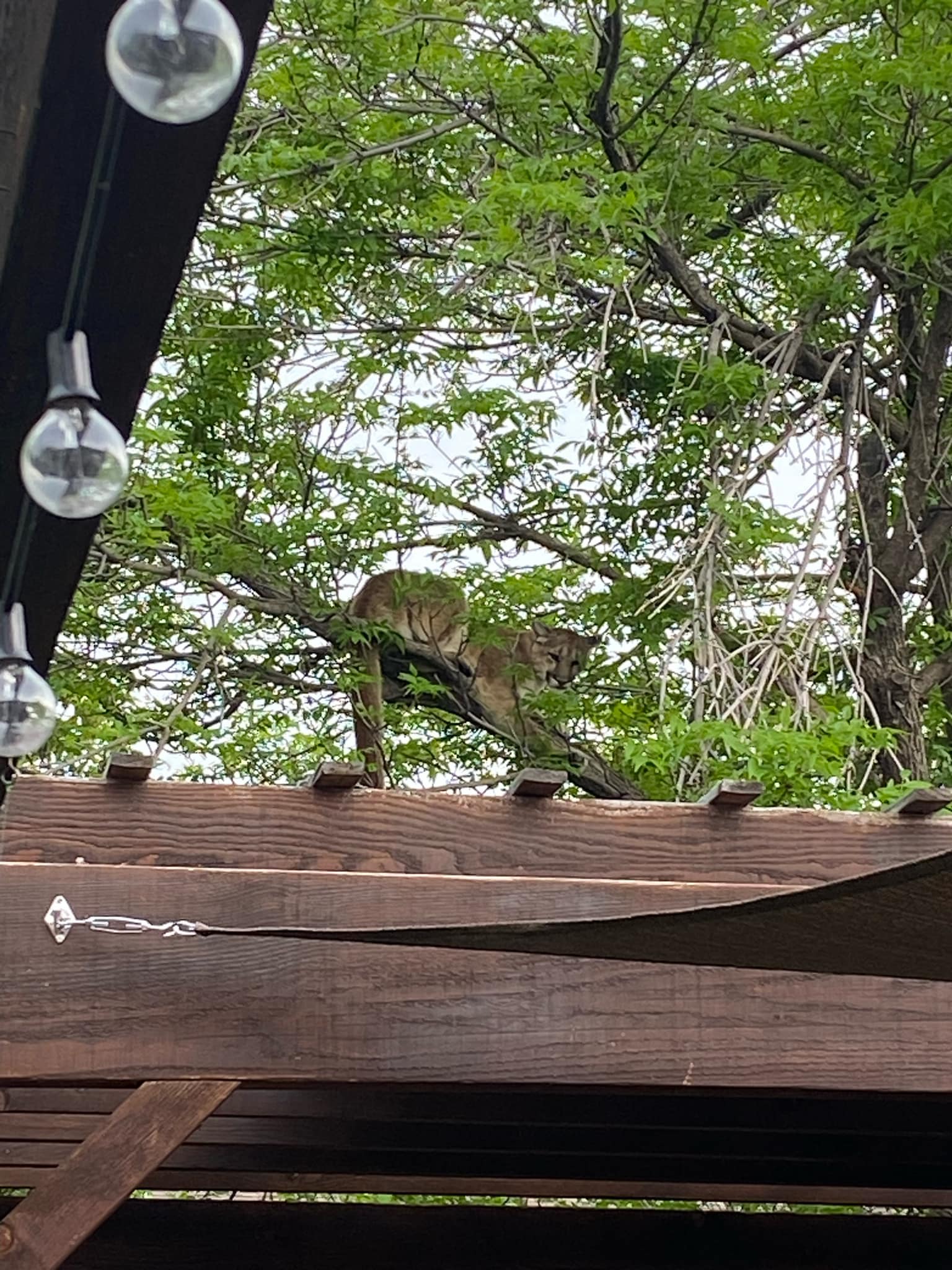
SPEARFISH, S.D. – Holly Hansen doesn’t have hard data to prove that potentially dangerous wild animals are entering residential areas with greater frequency, but she does have some pretty strong anecdotal evidence.
In early May, a black bear entered her suburban Spearfish property and killed 16 ducks, chickens and turkeys, she said. Large paw prints in the mud and two piles of bear scat provided evidence of the daytime intruder’s identity.
On May 23, an adult mountain lion was hunkered down in a tree at a home on Wyoming Court, well within Spearfish city limits and not far from two schools, a recreation center and two parks. State game officers tranquilized the lion and safely relocated it before any people were endangered. However, the property owner posted a note on social media indicating that her children likely walked beneath the big cat, whose method of killing animals can include an ambush from a tree limb overhead.
Also in May, a resident near Whitewood, between Spearfish and Sturgis, reported that a suspected mountain lion had killed a foal found dead on her ranch, according to the Lawrence County Sheriff’s Office.
Those incidents came amid numerous other wild animal sightings reported in residential areas across South Dakota. Among them: a mountain lion photographed on a street in west Rapid City in March and an encounter at Sertoma Park in Sioux Falls in May where a woman walking her dogs had to carry the canines and run from two coyotes that chased her.
“If they’re coming into town and they’re comfortable, that’s a different level of concern,” said Hansen, who has had mountain lions, coyotes, skunks and now a bear visit her Spearfish property, though only the bear attacked animals. “If they’re in your stuff, tearing animals apart and eating them, it’s a dangerous situation.”
Some wildlife interactions in residential areas are to be expected in South Dakota, where numerous cities border the Black Hills National Forest and other animal habitats.
But the lion removed from Spearfish in May should increase concerns about future interactions with humans, said Terry Mayes, a vice president of the South Dakota Wildlife Federation.
“He wasn’t up there to sleep overnight because that is their normal prey activity,” Mayes said. “They ambush from a branch above, and that’s how they get their major kills ... so there’s a potential for an encounter that could be very bad.”
Officials from the South Dakota Department of Game, Fish and Parks were unwilling to answer questions about wild animals encroaching into residential areas.
Mike Apland, a GFP supervisor in Spearfish, did not return calls or a text message seeking comment from News Watch.
GFP spokesperson Nick Harrington declined to answer questions about the topic or arrange an interview despite numerous email and phone requests.
Expanding research shows that expansion of urban life into animal habitat across the world is increasing, and as a result, so are human-animal interactions.
Those interactions lead to a fairly rapid change in wild animal behavior, making them even more likely to brush up against unsuspecting humans, according to a 2020 study published in “Frontiers in Ecology and Evolution.”
The increasing interface between wild animals and humans in non-wild areas is not good for either side of the equation, said Megan Howell, executive director of the non-profit South Dakota Wildlife Federation.
While feeding habits, a change in availability of food or water or illness can lead wild animals into residential areas, the biggest reason for increasing human interactions is loss of habitat for animals, Howell said.
Farmers and urban planners can improve practices to maintain animal habitat and provide buffers between wild areas and residential or crop lands, Howell said.
Public education can help residents maintain suburban or rural properties in ways that reduce animal interactions, and government and environmental groups can continue to seek money and methods to put more land under protection.
In South Dakota, an annual mountain lion hunting season began in 2005.
About 3,000 to 4,000 lion licenses are sold each year, and 2011-2012 was the last time the limit of 60 animals or 40 females was reached, with 73 animals taken in the Black Hills and Custer State Park.
In recent years, the kill total has ranged from a low of 21 in 2018-2019 to a recent high of 51 total in 2019-2020. So far in 2023, 44 lions have been killed, the largest a 153-pound male estimated to be 7½ years old taken in January in Pennington County.
In addition to habitat loss, the declining deer population in the Black Hills may be another reason mountain lions are migrating into residential areas, according to Mayes with the wildlife federation.
Deer populations — a primary food source for mountain lions — have declined slightly due to animal losses caused by the emergence of chronic wasting disease and epizootic hemorrhagic disease, a viral illness spread by midge flies, Mayes said.
One metric of deer population is the annual harvest by hunters, which reached a low of roughly 20,000 per year in the late 1970s, rebounded to nearly 100,000 a year in 2010 and recently has hovered closer to 50,000 annually.
Hansen, the Spearfish area resident, said she keeps animal feed and garbage in metal containers with lids to reduce enticements for wild animals.
The bear climbed a wood pile and broke through a fence before clawing and tearing up her animal houses, killing numerous farm fowl but also a “silly turkey” that had become a pet.
“I walked out there, and it was pretty devastating. There were dead animals and animal parts everywhere,” she said.
Hansen said she has shared her bear story with neighbors, but she feels like GFP officials have not done enough to inform the public. “I think we need to know so people can be prepared,” she said.
— This article was produced by South Dakota News Watch, a non-profit journalism organization located online at sdnewswatch.org.