

For years, retirees have been closely associated with South Dakota's population growth, especially in communities known for recreation and features of lifestyle.
But Census migration estimates tell a different story.
Working-age adults ages 18 to 64 represented the largest share of people moving into South Dakota from other states each year from 2021 through 2024, according to an analysis of U.S. Census Bureau data.
During that period, an average of about 21,000 working-age adults moved into South Dakota annually, compared with roughly 5,000 children and 2,000 retirees. In 2022 alone, more than 22,500 working-age adults moved into the state, while about 1,800 retirees arrived.
The findings suggest retirees remain an important part of South Dakota's migration story but are not the state's largest group of newcomers.
Working-age adults drive South Dakota's domestic migration David Sorenson, professor of economics at Augustana University in Sioux Falls, said statewide migration patterns challenge a common assumption.
'If the common conception is that it's elderly driving our migration, that's absolutely false,' Sorenson said.
He said some counties continue attracting retirees, but statewide data show working-age adults dominate migration. The findings also raise questions about who those workers are, including younger professionals, families and people approaching retirement.
Some newcomers are returning for connection, community and quality of life Danielle Schulz returned to White, South Dakota, after spending about 40 years in California.
She moved west at age 19 hoping to experience different cultures.
'I wanted to meet people from other countries,' Schulz said. 'I wanted to see a part of the world that I wasn't exposed to.'
She returned after her father's death gave her the opportunity to buy the family farm.
Although returning meant taking a substantial pay cut, she said the move offered something she valued more.
'I wanted solitude,' Schulz said.
She also wanted to reconnect with family and her community.
'The people you meet in your life are what keep you somewhere,' she said.
Sorenson said migration decisions often involve jobs, family ties and lifestyle preferences rather than a single factor.
The post-pandemic migration surge also coincided with expanded remote work and South Dakota's 'Freedom Works Here' campaign, although previous South Dakota News Watch reporting found local officials lacked evidence directly linking migration gains to the advertising effort.
Migration data shows arrivals but not whether people stay
Migration estimates measure people moving into South Dakota, but not whether they remain.
Jared McEntaffer, CEO of the Dakota Institute, said net migration – the difference between arrivals and departures – provides a better measure of long-term population growth.
'The net number is really important,' he said.
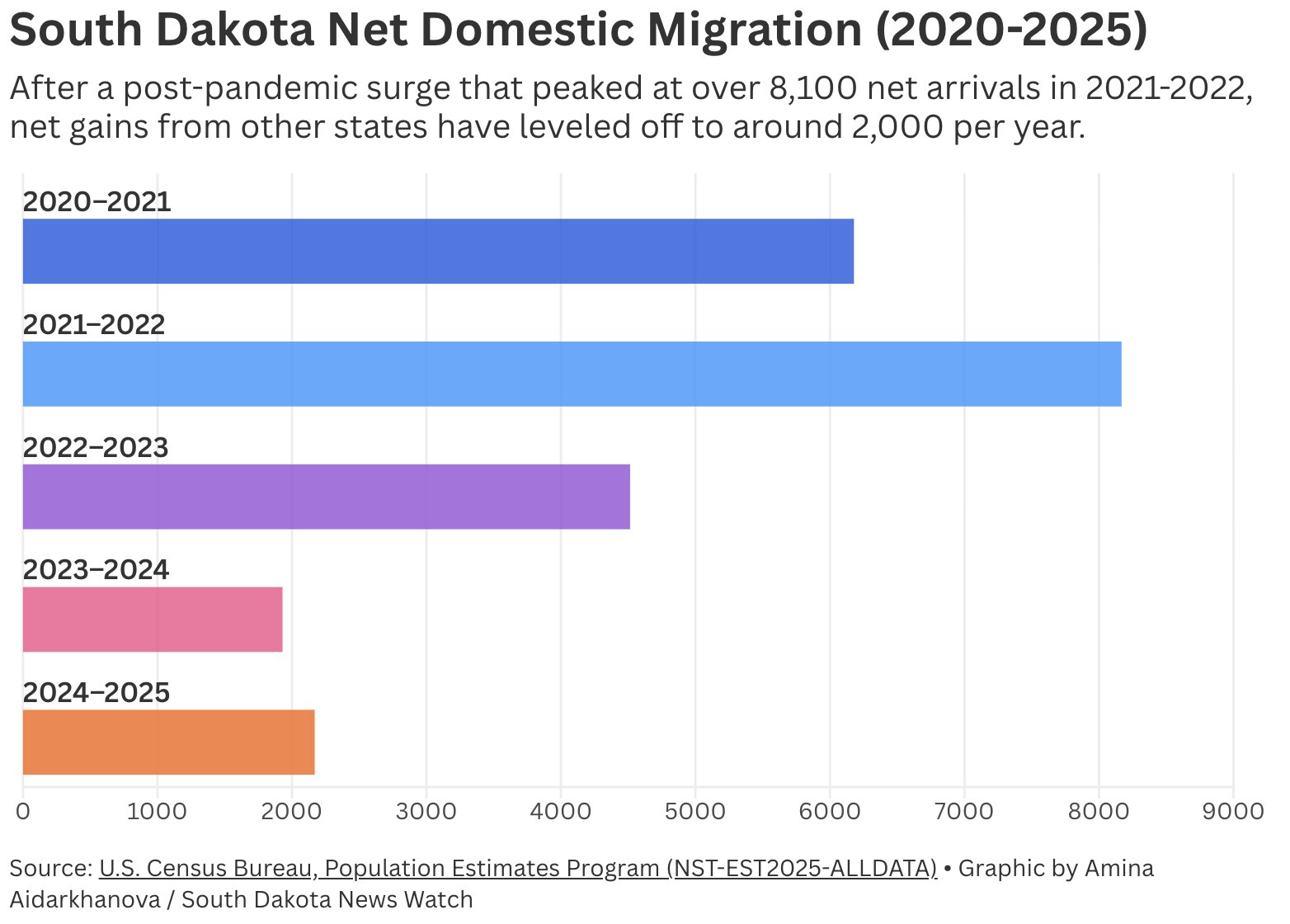
While more than 20,000 working-age adults moved into South Dakota annually during the study period, net domestic migration has slowed since its pandemicera peak. South Dakota gained more than 8,100 net domestic residents during 2021-22, but annual gains later dropped to about 2,000 as more residents left the state.
Sorenson also cautioned against drawing conclusions from a single year's estimates.
Retirees remain visible but may not drive statewide migration
Retirees continue to play an important role in parts of South Dakota, particularly in western counties that attract RV travelers and outdoor recreation enthusiasts, Sorenson said.
Migration patterns vary by county, meaning some communities attract more retirees while others draw younger workers and families.
A shift in 2024 raises new questions
In 2024, working-age migration declined while retiree migration reached its highest level during the study period. Both Sorenson and McEntaffer said more years of data are needed to determine whether the change represents a lasting trend.
'It raises your antenna,' Sorenson said. 'But you'd want to see this repeat or continue.'
Attracting newcomers is only part of the migration challenge For South Dakota, the larger question is not only who moves to the state, but whether those newcomers remain.
Working-age residents play a key role in the state's workforce and economy. Whether recent migration translates into sustained population growth will depend not only on attracting new residents but also on convincing them to stay.
South Dakota News Watch is an independent nonprofit. Read, donate and subscribe for free at sdnewswatch. org. Amina Aidarkhanova received the 2026 Jeffrey B. Nelson Investigative Journalism Endowed Internship and the Chuck Raasch and Sandy Johnson Scholarship from the SDSU Foundation. Contact: amina.aidarkhanova@sdnewswatch.org.